


Cart
0
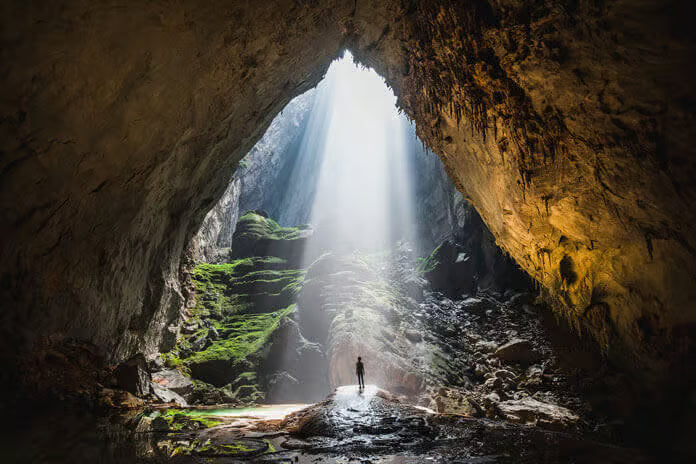
Son Doong is considered to be the largest cave in the world, based on volume and also the biggest cave in Vietnam, found by Ho Khanh – a Phong Nha jungle man in 1990. In 2009, Hang Son Doong was officially surveyed and measured by the The British -Vietnam Cave Expedition Team led by Howard Limbert. The Expedition team then announced it as the world's largest natural cave with a volume of 38.5 million m3. The measurements were then accepted by a number of world's senior karst geologists including Dr. Tony Waltham. This team along with National Geographic magazine had announced Son Doong Cave as the largest natural limestone cave on the planet in the same year. In 2013, the Guinness World Records Organisation recorded it as the world's largest natural cave.
Many people mistook Son Doong Cave - the largest cave in the world with Mammoth Cave - the world's longest-known cave system, located in Mammoth Cave National Park ( an American national park in west-central Kentucky) and that Son Doong is the largest cave passage. However, this article will clarify the misunderstanding as well as give you a better acknowledgement of Son Doong Cave and its exploration.
Origin of the name Son Doong
Traditionally, those who found the cave will name it. Therefore, Ho Khanh and the expert team discussed and decided to call the cave Son Doong (a combination of 2 words: Son means mountain, Doong is the name of the valley where the ethnic minority Bru Van Kieu lives, and the Thuong river coming from, or also means the cave in the limestone mountain with an underground river flowing through).
Unique features of Son Doong Cave
The Son Doong Cave has a total length of nearly 9 km long and the volume is up to 38.5 million cubic metres, which makes this cave the largest natural cave on the planet. With this volume, Hang Son Doong is 5 times larger than Deer cave in Malaysia, which was said to be the largest natural cave ( before Hang Son Doong was discovered) with 9.5 million cubic metres of volume. However, what makes Son Doong special, recognized and well-known by the world is the unique hidden underground world inside the cave itself. It has many complex and giant stalactites (over 80m high), primaeval rain forests growing inside the cave, its own ecosystem, weather or a mysterious underground river that no explorer has yet discovered to the end of it. Many visitors admitted that the Hang Son Doong Cave is like another world, Ginger Zee from ABC News's - Good Morning America exclaimed that the sceneries in Son Doong were like those in the Avatar movie.
This amazing cave also houses an impressive ecosystem, inside the largest cave passage in the world. This huge and intricate cave system was created by the underground river, and filled with formations from the water that percolated down from a rainforest above. More of the highlights only found in this cave are:
Hope and vision passage
There is one of the largest sections of Son Doong; from the beginning of this passage, you can see the light from Doline 1, 1.5km away. Estimated by cave experts that a 40-storey skyscraper can easily fit in this passage and it is large enough for a Boeing 747 to fly through. Moreover, the world's tallest stalagmite, about 80m tall, is also located in this passage.


Underground river :
There is an underground river inside Hang Son Doong Cave which is a combination of the water coming from En Cave and Khe Ry Cave (the longest underground river cave where the water comes from the Vietnam/Laos border area). From Son Doong entrance, you have to cross knee–deep rivers twice to reach the Hope and Vision Passage. There are emergency bridges in case of high water levels. The small waterfalls along the way create loud rumbles. Sometimes, the cave is filled with mist. This underground river disappears near Doline 1, about 4.5km away from the cave entrance.

Fossil passage :
Located next to the underground river at a depth of 40m below the campsite - Doline 1. This passage is imprinted with corals which have been fossilised hundreds of million years ago. This passage also has a 17 to 20 degrees Celsius underground lake in which visitors can swim and relax after a long hard trekking day. For safety reasons, life jackets and headlamps are required. Most visitors said that swimming in this cold underground lake is one of the best experiences that should not be missed in the Son Doong Expedition.


Doline 1: Watch out for dinosaurs :
The collapsed ceiling of Son Doong formed a big opening to the outside, called Doline 1 (or skylight). Approximately 450 m high from the top to the bottom. This is also where the underground river disappears. On sunny days, there will be giant sunbeams coming in (from about 11 am to 1 pm), especially from January to March every year. Due to the solar orbit, the sunbeams shine deep inside the cave, illuminating the large passages. The beam from above the sky and the mist from the underground river create a majestic scene that can not be found elsewhere. Google Doodle has displayed this magnificent moment in Son Doong Cave on its search homepage. Many people said that it is like another planet, while others thought it was like the movie Avatar.

Doline 2: Garden of edam
Located about 1km away from Doline 1, this Doline has a primaeval forest growing 200 m deep inside the cave, below the limestone mountains. Coming out of Doline 1, you will see a small path leading to the forest. With a big opening on the top, this Doline allows a huge amount of sunlight to get into the cave, creating good conditions for many species of ferns, begonias, and even large trees, growing up along the path. You have to trek for 30 minutes to cross this forest to reach the second campsite, Doline 2.


Cave pears :
Cave pearls formed from drips of water from the ceiling that carries calcite carbonate rippling down to the gour pools on the floor of the cave. They come in different sizes and shapes, from as small as peas to as big as baseballs. The Son Doong cave pearls are naturally formed inside the gour pool and look gorgeous under the headlamps, especially on rainy days when water is running through them. These cave pearls are just ordinary calcium carbonate deposits that have no value, they will be discoloured and plain when taken outside or left under direct sunlight, as they will very rapidly dry out.

Passchendaele Passage :
There is a 600m lake below the Great wall of Vietnam. When the expedition team first approached the area, all of the water in the lake had drained out, leaving a hip-deep muddy passage. The members of the expedition team had to work really hard to go across this 600m muddy passage. It somehow reminded them of the movie about the battle of Passchendaele in World War I, the team decided to use the name Passchendaele to name this long and difficult passage. In many other months of the year or when it rains a lot, the water will fill up the passage to form a big beautiful jade-green lake. During the occasions when the lake is full of water, tourists will use rafts or boats to go through the Passchendaele.

The great wall of vietnam :
In April 2009, after nearly 10 days of exploration and surveying, the expedition team reached a giant calcite flowstone, blocking all ways out, they decided to return due to the lack of specialised equipment for climbing over this giant wall. Right after leaving Hang Son Doong Cave, based on measured parameters, the expedition team announced Son Doong as the largest natural cave in the world. No one knew what was behind that large stalagmite, at the time, therefore they called it The Great Wall of Vietnam to describe its impressiveness.

Phong Nha - Ke Bang National Park
Son Doong Cave is located in the core zone of Phong Nha - Ke Bang National Park, near the Laos–Vietnam border which has twice been recognized by UNESCO as a World Natural Heritage Site; in 2003 and 2015.
Phong Nha - Ke Bang National Park was established in 2001 by Xuan Son jungle (1986) and Phong Nha nature reserve (1993). This is an area of 123,326 hectares, including 03 subdivisions: strictly protected subdivision (100,296 hectares); ecological restoration subdivision (19,619 hectares), and service administrative area (3,411 ha).
In 2003, Phong Nha - Ke Bang National Park was recognized by UNESCO as a world natural heritage with outstanding global criteria of geology, geomorphology, and geography for the first time. In 2009, it was recognized by the Government of Vietnam as a special national monument. In 2015, Phong Nha - Ke Bang National Park was recognized by UNESCO as a world heritage site for the second time with the criteria of outstanding global biodiversity.
Phong Nha - Ke Bang has the largest limestone massif in Southeast Asia with extensive cave systems and more than 400 caves found and surveyed. Ethnic minority people the Arem were living in caves many years ago.
Phong Nha - Ke Bang is rich in natural resources, the name is a combination of Phong Nha village located next to the forest, and Ke Bang - an ancient village located in the deep jungle in western Quang Binh Province. This combination is to show the vastness of the national park.

Phong Nha - Ke Bang cave systems
During the Vietnam war, many big caves in Phong Nha - Ke Bang National Park were used by Vietnamese soldiers to store weapons and food and to live and hide from bombs as well. However, the cave systems in Phong Nha were only known when cave experts from the UK led by Mr Howard Limbert, in collaboration with the Department of Geography, of Hanoi University of Science came to Vietnam and conducted dozens of surveys and discoveries since 1990.
As of 2022, after 32 years of surveying, the expert teams have discovered, surveyed, and measured more than 404 caves with a total length of 220km. Although many ones have been found over the past 32 years, cave experts said that only about 30% of the Phong Nha - Ke Bang limestone massifs have been surveyed. Explorations are still carried out every year.
Limestone caves form along 3 main rivers inside the limestone massifs, including the Phong Nha Cave System in Vietnam with En, Cold, Khe Ry, Son Doong, Thung, Va, Nuoc Nut caves, and Phong Nha Cave. The Vom Cave system in Phong Nha, Vietnam includes Ruc Ca Roong, 35, Pygmy, About, Tiger, Dai Cao, Ba, Tron, Sang, Vinh Dai, Vom Caves, and Paradise Cave. The Moọc Eco-spring system with Khe-Rung, Vuc Ky, and Ha Hai caves. The Moọc Eco-spring system has a huge amount of water flowing out, which is one reason why cave experts want to explore the system. As there are no large streams or rivers in this area, they have not been able to find any connections between this system and valleys in the limestone massifs such as Hung Xuong, and Hung Tri.

