


Cart
0
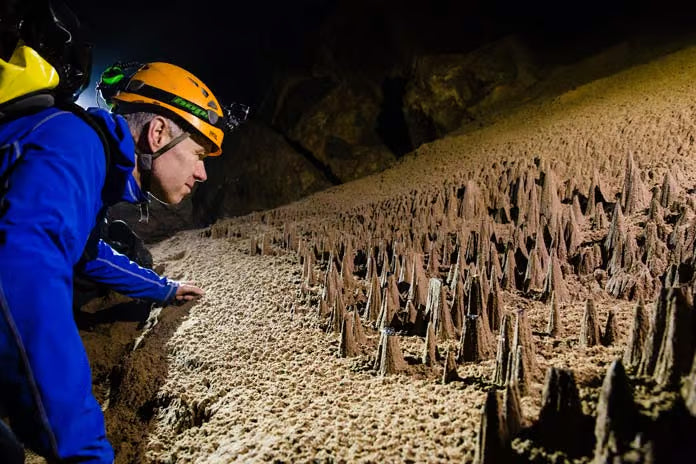
The journey to find Son Doong in Vietnam- the largest natural cave in the world started in 1994, when the expedition team had explored Hang En and Hang Thung, and realised there must be a cave in between. At that time, they had no idea what the cave would be like. Mr Hồ Khanh is a local man, born and raised in Son Trach Commune (now Phong Nha Town), Bo Trach District, Quang Binh Province, Vietnam. Since he was a teenager, Ho Khanh was a lumberjack, spending weeks in the jungle logging and poaching for very little income. In 1990, on a trip to the woods, while looking for agarwood (a very expensive plant), he encountered a thunderstorm and had to find a shelter, finding a small cave entrance below a cliff. As he approached, Ho Khanh saw mist blowing out and heard the sounds of a roaring river inside.
When he felt the strong cold wind blowing out, he decided to return without any further inspection. As time passed, he thought that cave was similar to many others found on his jungle trips, so he did not bother to remember the exact location.
In 2007, Mr Howard Limbert and Ms Deb Limbert – leading the members of The British Vietnam Cave Expedition Team came to Phong Nha and did some research and surveys of caves in the area. Based on the analysis of limestone topography, river systems and faultlines., Howard predicted that there was a very large cave after the exit of Hang En but he did not know the exact location of the cave. In a talk with Howard, Mr Ho Khanh coincidently mentioned the cave entrance that he accidentally saw with strong winds, dense fog and the loud sound of a roaring river echoing coming from the cave. Howard and Deb were very excited and urged Ho Khanh to try to remember the location and the way to where this cave is located.
Admiring the enthusiasm of Mr Howard and his team members, Ho Khanh diligently searched for the mysterious cave many years later. Supposed to be forgotten, in 2008, on another trip to the wood, Ho Khanh was lucky to find the location of the cave entrance. He carefully memorised the location and map the route to get to the cave entrance in his mind by orienting the mountains and trees. When he returned, he then tried to find a way to contact the expedition team.
On April 07, 2009, Howard Limbert led a caving expert team in collaboration with the Geography Department of Hanoi University of Science to survey the cave. The first person stepping inside Son Doong was Peter MacNab, a member of The British Vietnam Cave Expedition Team. This was also the first time Ho Khanh went inside the cave. During this expedition, they determined that this is the world’s biggest cave, in Vietnam with its own ecosystem. Ho Khanh and the cave expert team discussed and decided to call the cave Son Doong (A combination of 2 words: Son means mountain, Doong is the name of the valley where the Bru-Van Kieu ethnic minority people have lived since 1992 and it is where Thuong River comes from). Since then Son Doong Cave has become known around the world and has become a famous cave in Vietnam.


Son Doong cave discovery and survey timelines
- Early December 1990: Mr Ho Khanh on a jungle trip discovered the cave entrance, later known as Son Doong Cave.
- April 07, 2009: Ho Khanh took The British Vietnam Cave Expedition Team led by Mr Howard Limbert to survey and measure the cave. Peter MacNab was the first person to step inside.
- April 14, 2009: The cave was named and announced as the largest natural one in the world by The British Vietnam Cave Expedition Team.
- March 17, 2010: The exploring team climbed the Great Wall of Vietnam of the biggest cave in the world and exited the cave, completing the survey with a length of nearly 9 km and a volume of 38.5 million cubic meters. Son Doong Cave was declared by National Geographic TV as the largest natural cave in the world.
- If these caves were connected, the volume of Hang Son Doong cave in Vietnam would be increased by 1.6 million cubic metres.
- March 31, 2019: Howard Limbert and well-known cave diving experts such as Martin Holroyd, Rick Stanton, Jason Mallinson, and Chris Jewell carried out a dive exploration into the underground river inside Son Doong with the aim of finding the connection between Son Doong and Thoong (Thung) a gap of approximately 600m. The diving team found an underwater passage reaching a depth of 78m, though the overall depth of the passage was measured as 93m. With normal air cylinders, they could not dive any deeper or explore any further.
Surveys of Son Doong Cave
In April 2009 - Peter MacNab with Jonathan Sims, Adam Spillane, Trevor Wailes, Helen Brooke, and Nguyen Duc Hanh of the Geography Department, Hanoi University of Science was led by Ho Khanh to the entrance that would become known as Son Doong Cave. At the end of the cave, they found a very high flowstone blocking the way on. A glimmer of light could be seen high above. Without technical climbing equipment, they had to return. However, with the measurements made, Howard Limbert and the Expedition Team announced that they believed this cave was the largest natural limestone cave in the world.
In March 2010 - Howard Limbert and his team returned with specialised climbing equipment for the flowstone wall. There were scientists and a film crew from National Geographic TV to make a documentary film about the discovery of Hang Son Doong Cave as well as the process of climbing the calcite wall - later known as the Great Wall of Vietnam. After that, they walked for 400m more to reach the exit. The exploration was finally complete. With a volume of 38.5 million cubic metres, the cave is five times larger than the Deer Cave in Gunung Mulu National Park, Sarawak, Malaysia (with a volume of 9.5 million cubic metres).
Son Doong 2010 expedition diary with the National Geographic filming crew.


Hang Son Doong’s 3D map & names of locations in the cave

Location of Son Doong Cave
Located in the core zone of Phong Nha – Ke Bang National Park, Tan Trach Commune, Bo Trach District, Quang Binh Province, is home to the biggest caves in Vietnam and in the world, Son Doong is a new cave, located in the heart of the Phong Nha Ke Bang National Park, in Central Vietnam. It is considered the largest cave in the world, based on volume. Son Doong - Vietnam's largest cave was discovered by accident in 1990 by Ho Khanh and was only explored by the The British Vietnam Caving Expedition Team in 2009. Visitors have to spend 1.5 days trekking to reach the cave entrance, they will spend the first night in En cave and then approach Son Doong at noon the next day.
World records and media for Son Doong
Hang Son Doong were surveyed by the British Vietnam Cave Expedition Team led by Mr Howard Limbert in 2009. The Expedition team then announced it as the world's largest natural cave with a volume of 38.5 million m3, 5 times bigger than Deer Cave in Malaysia (the biggest before Hang Son Doong Cave was found in Vietnam) with a volume of 9.5 million cubic metres.
The measurements were accepted by a number of senior karst geologists including Dr Tony Waltham. The exploration of Hang Son Doong was later published by National Geographic Magazine and filmed for National Geographic TV.
- On April 30, 2013, the Guinness Book of World Records announced the 2013 book of world records, in which Hang Son Doong was named as the largest cave in the world. Link on Guinness website: guinnessworldrecords.com
- In 2014, Son Doong was voted by The New York Times as one of the 52 most attractive tourist destinations in the world.
- In 2015, the world's largest cave was filmed and live broadcast on ABC News ‘Good Morning America’.
- In the same year 2015, National Geographic magazine published a 360-degree photo series and interactive website taken inside Son Doong cave.
- In 2019, DJ Alan Walker made a music video titled Alone P.II in Son Doong Cave and released it on youtube on December 27, 2019. By October 2022, this MV reached over 275 million views.
- In 2020, the Cave was voted by Business Insider as one of the 20 outstanding natural wonders.
- In 2021, Son Doong 360 photo series on National Geographic became a hot virtual reality tour in the world during the Covid pandemic.
- On April 14, 2022, Google Doodle honoured Hang Son Doong Cave on its search page in 18 countries around the world, including Vietnam, Argentina, Chile, Costa Rica, the Dominican Republic, El Salvador, Greece, the Republic of Guatemala, Republic of Honduras, Mexico, Republic of Moldova, Romania, Singapore, Sweden, Thailand, U.S. Virgin Islands, United Kingdom, and Brazil.
- November 26, 2023: Sơn Đoòng Cave was featured in episode 6 of Planet Earth III - Extreme, a popular BBC nature documentary series.

Tourism activities
Before 2011, caving tourism in Phong Nha - Ke Bang mainly focused on caves such as Phong Nha, Tien Son, Thien Duong, Dark, and Mooc Eco-spring on a large scale. These tourist places welcome about 500,000 visitors every year. Most of these tourists stay in big cities such as Dong Hoi, Hue, and Da Nang after their visit. So local people did not have many opportunities to take part in tourism activities, which led to difficult living conditions due to unemployment and many people had to continue going into the forest for illegal logging and hunting.
In 2013, the Son Doong Expedition tour was approved by Quang Binh authorities as an adventure tour with a duration of 6 days and 5 nights, operated by Oxalis Adventure. The expedition immediately resonated around the world, and many major newspapers and Hollywood filming crews came to film and tell the news. Son Doong has contributed to the promotion of Quang Binh as a world tourism destination. From the effect of Son Doong, many tourism services opened in the region, other tours were developed, and hundreds of homestays were built to serve tourists. Emmy Award-winning filmmaker Sid Perou travelled to Phong Nha and Son Doong and made a 40-minute documentary titled: "Son Doong- the cave that built a village".
Phong Nha - Ke Bang in which many caves are located is today the best cave tour destination in Vietnam for domestic and international tourists. Thanks to that, the living standards here are getting better and better. There are many other famous caves in Vietnam located in Tan Hoa, Minh Hoa, Quang Binh such as Ken Cave, Song Cave and others in the Tu Lan Cave System
The values of Son Doong cave
After a few pilot tours in August 2013, Son Doong Expedition was officially launched in 2014 by Oxalis. Following the core values of safety, conservation, and community involvement, Oxalis Adventure has been continually trying to support Phong Nha - Quang Binh in particular and Vietnam in general.
Hang Son Doong Cave is confirmed as the largest natural cave in the world by many domestic and international organisations. From its values, the cave has contributed a lot to Quang Binh's tourism development, bringing this province to the world tourism map.
Thanks to Son Doong, other tours and services in the region have opened and developed. A lot of homestays and hotels were built for tourists and many people have jobs with stable incomes. The Son Doong tour has created jobs for 125 men in Phong Nha and hundreds of indirect jobs for locals through food supplies, accommodations, transfers, and many others.

Geology and geomorphology
Son Doong is located in the oldest and largest limestone massif in Southeast Asia with an age of more than 400 million years. Limestone was formed from 2 sources: chemical and biological. Chemical limestone is made up of the precipitation of CaCO3 from Ca(HCO3)2 solution in seawater. Bio-limestone, also called biotic, was formed mainly from the skeleton and shells of organisms with a CaCO3 composition. Types of shells, snails, and most corals would make up limestone. Due to the movements of the earth's crust, the layers of sediment rose and formed the limestone mountains as they are today. According to scientists, Son Doong was formed about 2-3 million years ago along a fault of the Truong Son Range, the modern-day Thuong River now passes through Son Doong Cave.
Dissolved carbon dioxide makes rain and river water weakly acidic, which allows the water to dissolve limestone, eroding it over millions of years. The tropical rainfall, wide fault lines and thick limestone beds have enabled the creation of a huge tunnel beneath the mountains. There were places where the cave ceiling was too thin, causing collapses and forming the dolines, and creating the magnificent Son Doong Cave as it is today. The length of Son Doong cave is nearly 9 km, at some points, the height is up to 200m and the width is 160m, large enough to accommodate 40-storey buildings. With a volume of 38.5 million cubic metres, Son Doong surpassed Deer Cave in Malaysia to become the largest natural cave in the world. The formation of Son Doong is still ongoing.


Ecosystem inside Son Doong Cave
Son Doong is currently the largest underground cave in the world with a length of nearly 9km. There are cave passages with a height of over 200m, and more than 150m wide. At some points, the ceiling has collapsed, creating dolines (skylights) that allow light to enter inside and provide a suitable environment for plants to grow. Biologists have found more than 200 species of plants living in Hang Son Doong, including algae, moss, vines, shrubs, and small to large trees (30m high).
An underground river flows in the cave, which is home to many species of fish, which are developed to adapt to the eternal darkness of the cave. Up to now, in Son Doong Cave, biologists have found more than 7 new species of animals, including some species of fish, woodlice, millipedes, spiders, and scorpions... with the same feature of no eyes and transparent bodies.
Son Doong Cave has a very large volume that can accommodate skyscrapers, there are wide sections enough for a Boeing to fly through besides streams, waterfalls, and a primaeval forest. With such a huge size, Son Doong has its weather system, the temperature is around 22 to 25 degrees Celsius in summer and 15 to 20 degrees Celsius in winter. It is always lower than outside from 8 to 12 degrees Celsius in the summers due to the effect of lack of sunlight, damp atmosphere and difference in air pressure, causing airflow.
With those unique features, mother nature has created a very interesting ecosystem inside Son Doong cave that is nowhere else.


Undiscovered mysteries of Son Doong Cave
After conquering the Great Wall of Vietnam in 2010, cave experts found the exit and completed the mapping of Son Doong Cave. However, this cave still contained some mysteries. During the explorations from 2010 to 2022, Howard Limbert’s team discovered, surveyed, and measured many giant caves around Son Doong in Vietnam. When exploring and surveying Hang Va in 2012 (discovered by Ho Khanh in 1992), they found out that Hang Va is located close to Son Doong exit, about 50m away.
During the survey of Son Doong, cave experts found that the underground river disappeared into a flooded passage below Doline 1, about 4.5km from the entrance. They suspected this river would connect to Thoong (Thung) Cave 600m away. In 2019, Howard Limbert and Martin Holroyd, with Chris Jewell, Rick Stanton, and Jason Mallinson (who participated in the rescue of a child soccer team trapped in Tham Luong cave, Chiang Rai, Thailand) dived to a depth of 78m and found an underwater cave passage. Due to a lack of equipment for diving deeper, they decided to stop the survey and announced they had found an underwater passage found at 60m and descending to 78m with no end in sight. If they could find the connection between Son Doong and Thung Cave, Son Doong's volume would increase by 1.6 million metres. Son Doong - the massive cave in Vietnam still contains many mysteries that are waiting for explorers to discover. Please learn more about the survey of the underground river inside Son Doong in 2019 here. It is expected that in March 2023, the cave diving expedition led by Mr Howard Limbert, including John Volanthen and Martin Holroyd will continue.

